
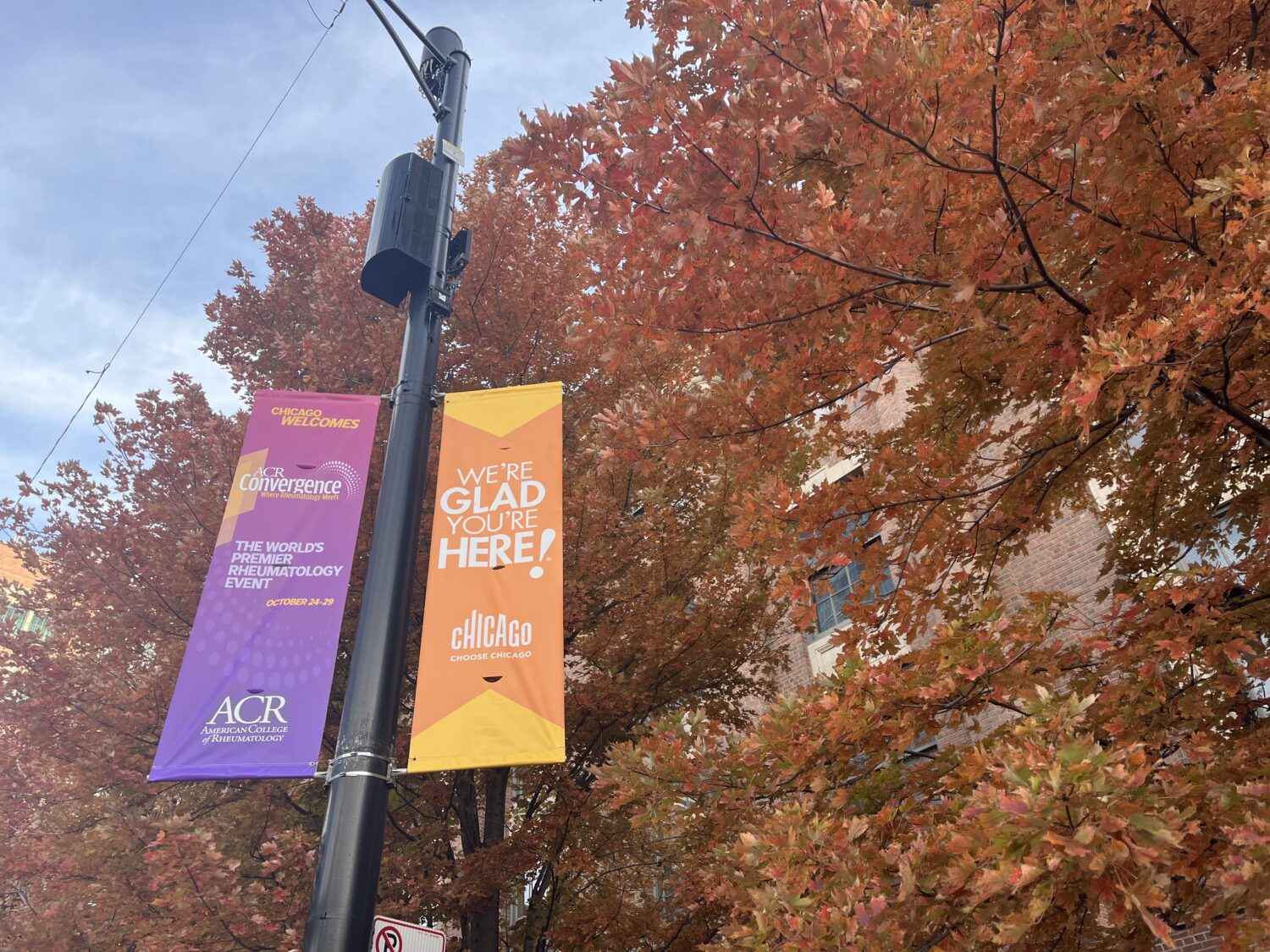
Chicago is home to the 1893 World’s Fair, the Cubs, and, for four days in October, thousands of rheumatologists meeting to discuss the latest research, advancements, and breakthroughs in the field.
The 2025 American College of Rheumatology (ACR) Convergence conference took place from October 24-29 at McCormick Place in Chicago. Gout and other crystal arthropathies were discussed in scientific sessions, abstract presentations and CME courses during the conference.
The Gout Education Society (GES) exhibited at conference, connecting with medical professionals looking to gather resources for patients, learn more about the Society, or sign up for our Gout Specialists Network.
While at ACR, we also attended several sessions to stay up-to-date with the latest on gout, from research and potential new therapies to patient perspectives. Read on for a few of the highlights.
Understanding Gout Comorbidities
In “Gazing into the Crystal Ball: Gout and Cardiometabolic Comorbidity Management,” multiple presentations dove into a common occurrence with those suffering from gout: comorbidities.
Natalie McCormick, PhD, Massachusetts General Hospital, spoke on the metabolic syndrome — a cluster of conditions that increase the risk of developing chronic diseases such as heart disease, stroke, and type 2 diabetes — and gout prevalence in her presentation, “The Metabolic Syndrome and Development of Gout.” Her research found that 63% of U.S. adults who have gout have metabolic syndrome.
“[Patients and medical professionals] really need to be aware of gout being a systemic condition,” she said. “You really need to look at the whole picture.”
GES International Advisory Council member Jasvinder Singh, MD, MPH, Baylor College of Medicine, focused on cardiovascular comorbidities in gout patients in his presentation, aptly titled “Cardiovascular Morbidity and Mortality in Gout Patients.”
His research found that gout — especially untreated gout — is a risk factor for cardiovascular events such as myocardial infarction, commonly known as a heart attack, and atrial fibrillation, a common heart rhythm disorder.
“There is emerging evidence that treating gout with urate lowering therapies may also give us some protection against these risks, even though they are small,” he said. “Given how prevalent these cardiovascular conditions are in the U.S. population, the absolute event reduction is very meaningful.”
In her presentation, “Treatments of Gout and its Metabolic Risk Factors,” Naomi Schlesinger, MD, University of Utah,discussed therapies that treat gout and its cardiometabolic risk factors, like cardiovascular disease, heart failure, hyperlipidemia, and more.
“It’s all about inflammation,” she said, adding that SGLP2 inhibitors and GLP-1 agonists are “the new things” when treating gout comorbidities.
Puja Khanna, MD, MPH, University of Michigan, helped moderate the panel and emphasized the importance of a systemic approach to gout treatment and management.
“Identify, recognize it early, and start treatment early, and don’t ignore the comorbidities that go alongside [the disease] … I think we just have to change our paradigm of gout management,” she said.
Crystal Arthropathies Research
In the panel, “Abstracts: Metabolic & Crystal Arthropathies – Basic & Clinical Science,” presenters explored lab-based research, from colchicine and gene expression to the promising results of Nanoencapsulated Sirolimus Plus Pegadricase (NASP).
In his presentation, “The effect of prophylactic colchicine use on gene expression in gout,” Austin Wheeler, MD, University of Nebraska Medical Center, presented research that looked at the potential mechanisms behind how colchicine affects the whole body in people with gout. An overexpressed gene, LINC02470, affects the immune system and is closely related to CLEC12A, which helps control the body’s reaction to gout crystals. The gene SLC2A5 is essential for fructose-induced hypertension, and its reduced expression with colchicine suggests one potential link to cardiovascular disease risk reduction.
In “Nanoencapsulated Sirolimus Plus Pegadricase Reduced Disease Burden in Patients With Uncontrolled Gout: Results From the Phase 3 DISSOLVE Trials,” Dr. Khanna presented research looking into reducing symptoms for those with uncontrolled gout. The study found that patients treated with NASP had important improvements in their gout, as shown by lower levels of uric acid and better reported health outcomes. This treatment helped ease sudden gout symptoms after six sessions and may also help improve the quality of life for people with gout.
In “Nanoencapsulated Sirolimus plus Pegadricase (NASP) Demonstrates a Reduction in Gout Flares: Results from the Phase 3 DISSOLVE Studies,” Angelo Gaffo, MD, FACP, University of Alabama at Birmingham, presented research looking into the reduction of gout flares with patients on NASP. The study found that the number of gout flares dropped compared to the placebo, with 95% of those on both high and low doses of NASP had no gout attacks by weeks 21-24. The research concludes that NASP is a promising treatment to reduce symptoms and improve health in those with uncontrolled gout.
In “Multi-omics Integration Reveals Gut Microbiota–Metabolite Dysregulation in Gout with Metabolic Syndrome,” Yuanpiao Ni, MMed, North Sichuan Medical College, presented research on gut bacteria and metabolism changes in people with gout, both with and without metabolic syndrome. The findings show how gut bacteria and body chemistry interact in these conditions, which may help doctors personalize treatments in the future by using specific disease markers.
Patient Perspectives
Every year, ACR Convergence gives practitioners a look into the patient perspective and experience in “Patient Perspectives.” In this year’s iteration, those diagnosed with diseases like psoriatic arthritis, relapsing pilychondritis, lupus, schleroderma, and gout shared their journeys. Each patient emphasized the importance of medical providers actively listening to patients to improve care outcomes.
In his presentation, “From Invisibility to Advocacy: A Gout Patient’s Journey to Validation and Systemic Change,” Gout Support Group of America co-founder Gary Ho shared his own 20-plus-year journey with gout, from first showing symptoms at 24 to finally receiving diagnosis and treatment.
“A patient understands their condition,” he said. “[We] know what [we] know, and we’ve lived it. And when we come in and make that time to see a physician … There’s a lot of hurdles even to get into the office, and that short amount of time is so valuable.”
Dr. Khanna, who organized this year’s “Patient’s Perspectives” panel, emphasized that having open, two-way communication ensures the best outcomes for both the patient and the medical professional.
“We as clinicians see the patient for an hour or 30 minutes during an office visit. We don’t necessarily know what their struggles have been before they got to us and what all they struggle with after we have given them a so-called ‘diagnosis.’ It’s not just learning what your diagnosis is; it’s also about coping with the disease and understanding [it].”
ACR Convergence 2026 takes place from Nov. 6-11 in Orlando, Florida. Visit gouteducation.com for more information on gout. Follow our socials to find us next year at ACR Convergence 2026.